


Does the servo drive board have overcurrent, overvoltage, and overheat protection?
Feb 04, 2026
Servo drive boards usually have overflow, overpressure and overheating protection. These protection mechanisms are core design functions to ensure the safe and stable operation of the servo system. The specific analysis is as follows:
1.Overcurrent Protection: prevents equipment from being damaged by current overload.
Function: When the motor's operating current exceeds the safety threshold set by the driver, overcurrent protection will be triggered immediately, cutting off the power supply or limiting the current output to prevent the motor, cable or drive board from overheating.
Trigger Scenarios:
Sudden load changes (e.g., mechanical jamming, impact).
Short-circuit or winding grounding fault of motor phase.
Internal power components (e.g., IGBTs) on the drive board were damaged.
For example, in injection molding machine, the hardening of guide rail lubricating grease increased friction coefficient, which leads to a sudden increase of motor current. This triggered overcurrent protection, stopping the machine and preventing further damage.
2.Overvoltage Protection: Dealing with abnormal voltage fluctuations.
Function: When input voltage exceeds the rated voltage range of the drive board (e.g., 460V in a 400V system), overvoltage protection is activated to prevent circuit components from being damaged by overvoltage.
Trigger scenario: Instant voltage surges ((e.g., lightning, sudden load changes in the power grid.
Regenerative braking energy is not dissipated in time (reverse voltage produced during motor deceleration).
The solution: Use an external braking resistor to burn off excess energy.
Enable dynamic braking to extend deceleration time.
Configure energy feedback units (e.g., high inertial load cases).
Case study: A Delta servo drive triggers overvoltage protection due to voltage fluctuation in power grid; this problem was solved by installing voltage regulator.
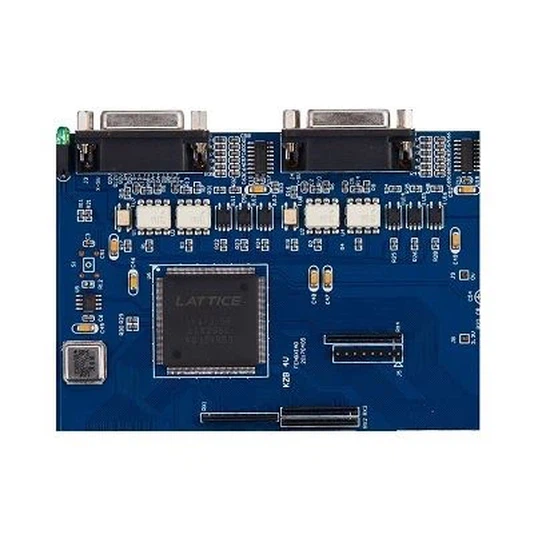
3. Overheat Protection: prevents performance degradation or damage caused by high temperature.
Function: using temperature sensor to monitor the temperature of drive plate or motor in real time. When the temperature exceeds the warning value (e.g. 85°C for IGBT modules and 65°C for heat sinks), it automatically shuts off or operates at a reduced temperature.
Trigger scenario: cooling fan failure or air ducts blockage.
Excessively high ambient temperature or the equipment is extended to run at high load.
Aging of thermal grease leads to a decreased thermal conductivity.
Maintenance Recommendations: Wash heat sink regularly (every 2000 hours).
Replace hot paste (Shin-Etsu X-23-7762 recommended).
The temperature of the power power module checked using an infrared thermal imager.
Case study: A servo driver overheated due to dust accumulation in its heatsink. It was cleaned and returned to normal operation.
You Might Also Like
-
Circuit Board Contract Manufacturing
-
Air Conditioner Universal Control Board
-
Wide Temperature Industrial Door Control PCBA Solution
-
High-Reliability Medical Grade PCBA ISO 13485 Certified
-
SMT PCB Assembly PCBA Manufacturing BLDC Motor Speed Cont...
-
High-Precision Automatic Door Controller PCB Assembly